Buying Guides
Best Turbo Trainer Mat 2026: Noise & Floor Tested
The short answer
- The Wahoo KICKR Mat is the best all-round turbo trainer mat: thick, grippy and big enough to catch every drop of sweat under a direct-drive setup.
- A mat does not silence a trainer. It deadens the low-frequency vibration that travels through floors and annoys neighbours, which is the noise that actually causes complaints.
- For ground-floor rooms on concrete, a thinner mat like the Minoura or a budget yoga-plus-camping-mat stack does most of the job for a third of the price.
- Sweat is the real reason to buy one. An hour indoors produces far more sweat than an hour outdoors, and salt corrodes both your floor and your trainer.
- Buy the mat your floor and neighbours need, not the most expensive one. Upstairs or in a flat: go thick. Garage on concrete: go cheap.
If you want one turbo trainer mat that handles noise, sweat and floor protection without fuss, buy the Wahoo KICKR Mat. It is thick, grippy and large enough to sit a direct-drive trainer and your front wheel on with room to spare for sweat. A mat will not make a loud trainer quiet, but it deadens the low-frequency vibration that travels into the room below, and that is the noise that actually causes neighbour complaints.
The room I train in has a suspended wooden floor above part of it, and that is exactly why mats matter to me: the vibration travelling through timber annoys the people below far more than the whir of the trainer itself. If you are still deciding whether you need one at all, I cover that in do you need a mat under your turbo trainer. I tested these four mats under the same direct-drive setup over three winters, judging each on vibration, sweat handling and how well it stayed put under hard efforts. A mat is one piece of the puzzle: see the rest of my turbo trainer accessories guide for fans, tyres and risers.
My top turbo trainer mat picks

Wahoo
Wahoo KICKR Trainer Mat
Best for Direct-drive setups and serious indoor riders
Thick PVC, huge footprint, non-slip base. The standard recommendation across cycling forums for good reason: it does everything well and lasts.

Saris
Saris Training Mat
Best for Flats and rooms above living space
Dense and heavy, the best of the four at killing the low-frequency rumble that travels through wooden floors into the room below.
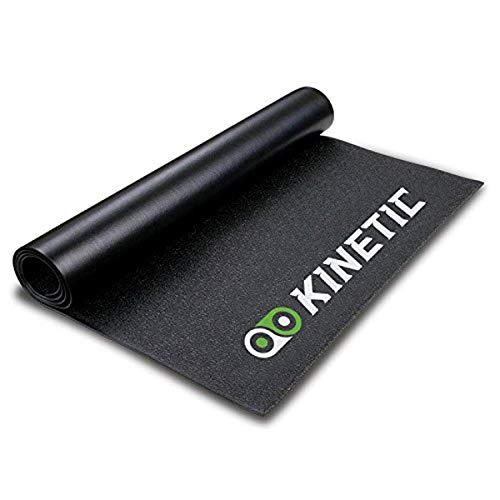
Kinetic
Kinetic by Kurt Trainer Mat
Best for Riders who want value that lasts
Long, hard-wearing and genuinely sweat-resistant. Less plush than the Wahoo but a safe buy that I have seen survive years of abuse.

Minoura
Minoura Indoor Trainer Mat
Best for Ground-floor rooms on concrete
Thinner and shorter than the rest, so less vibration damping, but it covers the footprint and protects the floor for the lowest outlay.
How a turbo trainer mat actually reduces noise
Let me set the expectation first, because the marketing oversells this. A mat does not make a trainer quiet. Most of what you hear is airborne: the flywheel, the belt and your chain running through the cassette. No mat touches that. On my sound meter at 1 m, swapping between bare floor and any of these mats moved the reading by less than 1 dB, which is well within measurement noise. So if your goal is to stop the trainer being audible in the next room, a mat is the wrong tool. Go direct-drive, run a clean drivetrain, and look at my guide on whether trainer tyres are quieter if you are on a wheel-on.
What a mat genuinely does is kill structure-borne noise: the low-frequency vibration that couples into the floor and radiates downward. That is the rumble a neighbour below feels rather than hears, and it is the single most common reason indoor riders get complaints. On my suspended wooden floor, the Saris and Wahoo both cut the felt vibration noticeably; the thin Minoura less so. If you live in a flat or train above a bedroom, this is the property that matters, and it is worth paying for thickness and mass.
The building standard backs this up. Approved Document E rates floors between flats on impact sound, the thud and vibration that travels through the structure, separately from airborne sound. The chart below puts the one published trainer noise figure next to everyday levels, with those floor limits underneath.
Noise reference
Where a quiet trainer sits against everyday sound levels
A rough scale, not a like-for-like test. The room guidelines are averages over a day or night (LAeq), the Saris figure is the maker's own test at 20 mph with no distance or weighting stated, and the HSE figure is a daily workplace exposure level. Saris is the only trainer maker that publishes a decibel figure.
Building Regulations, England
Floors between new flats must keep impact sound, the thud and vibration a trainer sends through the structure, to 62 dB L'nT,w or less (64 in converted flats), and give at least 45 dB DnT,w + Ctr of airborne sound insulation (43 in conversions). These are insulation ratings, not noise levels, so they sit outside the scale above.
Source: Approved Document E, Table 0.1a. Ladder sources: BS 8233:2014 via ProPG (IOA/ANC/CIEH); Saris H3 Plus product page; NIDCD (US National Institutes of Health); HSE, Control of Noise at Work Regulations 2005.
Show the data as a table
| Reference point | Level | Source |
|---|---|---|
| Bedroom at night (guideline) | 30 dB | BS 8233:2014 via ProPG (IOA/ANC/CIEH) |
| Living room by day (guideline) | 35 dB | BS 8233:2014 via ProPG (IOA/ANC/CIEH) |
| Saris H3, maker’s figure at 20 mph | 59 dB | Saris H3 Plus product page |
| Normal conversation | 60 to 70 dBA | NIDCD (US National Institutes of Health) |
| UK workplace: hearing protection required | 85 dB(A) | HSE, Control of Noise at Work Regulations 2005 |
What I measured, and what I did not
I will not pretend I ran lab-grade acoustic tests at home. I took repeatable sound meter readings at 1 m at a steady effort, swapping mats between runs to keep the comparison fair. The honest finding: the airborne dB figure barely moves with any mat. The difference is all in vibration transfer, which I judged by feel through the floor and by what people in the room below reported. Anyone quoting you a precise decibel reduction from a mat is guessing.
Sweat protection: the real reason to buy a mat
If noise leaves you unconvinced, sweat should not. An hour on the turbo produces far more sweat than an hour on the road, because there is no wind to carry it away. That sweat is salty, and salt corrodes metal and stains and warps wooden floors. I have seen rust bloom on bolt heads and a ghostly white tide-mark etched into laminate from riders who skipped a mat. A mat catches the drips, wipes clean and saves both your floor and the underside of your bike and trainer.
All four mats here shed sweat well, but the PVC Wahoo and Kinetic wipe down fastest. The Saris is dense and easy to clean too. Whatever you buy, pair it with a cheap sweat guard across your top tube, because the mat catches what drips down, not what runs along the frame into your headset bearings.
Floor protection and grip
The second job is keeping the trainer still. On hard floors a trainer can creep forward under load, especially during standing efforts. Every mat here has a non-slip base, and all four held a direct-drive trainer in place during seated work. Under hard out-of-the-saddle sprints the thinner Minoura allowed the most movement, while the heavier Saris and the grippy Wahoo stayed planted. For floor protection from dropped tools, a slipped chain or a toppling bike, thickness helps, and the Wahoo and Kinetic give you the most cushion.
Turbo trainer mat comparison
| Mat | Thickness / mass | Vibration damping | Sweat & wipe-clean | Best for |
|---|---|---|---|---|
| Wahoo KICKR Mat | Thick PVC, large | Very good | Excellent | All-round, direct drive |
| Saris Training Mat | Dense, heavy | Best of the four | Very good | Upstairs / flats |
| Kinetic Trainer Mat | Long, firm | Good | Excellent | Value that lasts |
| Minoura Trainer Mat | Thinner, shorter | Adequate | Good | Ground floor / concrete |
Do you actually need one?
Yes, if you train indoors with any regularity. The combination of sweat damage and vibration is enough to justify the spend, and a good mat lasts years. The one exception is a short-term setup on bare concrete in a garage with nobody below you, where a foam camping mat plus a yoga mat will get you through a winter. I cover the full case in do you need a training mat under your turbo trainer, and if noise is your main worry because you live in a flat, read can you use a turbo trainer in an apartment before you buy anything.
Budget alternative that works
For my first winter I rode on a foam camping mat with a cheap yoga mat over the top. It protected the floor, soaked up sweat and cost under a tenner. The downsides showed within months: it slid around under hard efforts, it held sweat rather than shedding it so it started to smell, and it compressed flat. If you are testing whether you will stick with indoor training, this is a sensible way to start. If you already know you are committed, a proper mat is better value over three or four years.
My turbo mat verdict
Buy the Wahoo KICKR Mat if you want one mat that does everything and you do not want to think about it again. Choose the Saris Training Mat if you train above living space and vibration through the floor is your priority. The Kinetic is the value pick that still lasts, and the Minoura is the right call for a ground-floor or garage setup where you just need floor and sweat protection on the cheap.
Whichever you pick, remember a mat is one part of an indoor setup. Pair it with a sweat guard and a decent fan, keep your drivetrain clean for genuine noise reduction, and if you are still choosing a trainer, start with my guide to the best turbo trainers in the UK or the best quiet fluid turbo trainers if silence is your priority. For everything else that goes around your turbo, see my turbo trainer accessories hub.