Buying Guides
Best Smart Turbo Trainers for Zwift 2026: Tested
The short answer
- The Wahoo KICKR Core 2 is the best all-round smart trainer for Zwift: best ride feel, power that tracked closely against a separate power source, and WiFi that kills Bluetooth dropouts.
- For Zwift you need a smart trainer with ERG mode, gradient simulation and dual Bluetooth plus ANT+ FE-C connectivity; a basic speed sensor is not enough.
- The Saris H3 has the best ERG mode I have tested and the highest gradient ceiling here at 20%, ideal for TrainerRoad and Zwift workouts.
- The Tacx Flux 2 supports the heaviest riders (125 kg) and is the value direct-drive pick, but it needs mains power; the Elite Suito-T folds away but its small flywheel makes climbs feel choppy.
- On a tight budget, buy a KICKR Snap used or wait for a sale: it is a wheel-on smart trainer with real ERG mode at well under direct-drive money.
The best smart turbo trainer for Zwift in 2026 is the Wahoo KICKR Core 2. After two winters of Cat B racing on these trainers, it gave the most natural ride feel, the steadiest power and the fewest connection headaches, and WiFi removed the Bluetooth dropouts that ruin a race finish. If your budget is tighter, the Tacx Flux 2 is the value direct-drive pick, and a used Wahoo KICKR Snap is the cheapest route into real Zwift training without giving up ERG mode.
I have raced and trained on every trainer here rather than bench-testing them, and the picks below come down to how each one actually behaved during ERG intervals and race finishes. The accuracy, power and gradient figures in the table below are the manufacturers’ published claims; my own impressions stay qualitative.
Best smart turbo trainers for Zwift at a glance
| Trainer | Type | Max W | Gradient | Claimed accuracy | Best for |
|---|---|---|---|---|---|
| Wahoo KICKR Core 2 | Direct drive | 1800 W | 16% | +/- 2% | Best overall / racing |
| Saris H3 | Direct drive | 2000 W | 20% | +/- 2% | ERG workouts |
| Tacx Flux 2 | Direct drive | 2000 W | 16% | +/- 2.5% | Value / heavier riders |
| Elite Suito-T | Direct drive | 1900 W | 15% | +/- 2.5% | Small spaces |
| Wahoo KICKR Snap | Wheel-on | 1500 W | 12% | +/- 3% | Budget / buy used |
Wahoo
No manufacturer photo available
Wahoo
Wahoo KICKR Core 2
Best for Zwift racing and all-round training
Best ride feel of the group, power that tracked closely against a separate power source, WiFi and Race Mode. The trainer I keep coming back to.

Saris
Saris H3 Smart Trainer
Best for ERG-mode workouts and TrainerRoad
The smoothest, fastest-reacting ERG mode I have used, 2000 W and 20% gradient. Quiet enough for a shared house.
Tacx
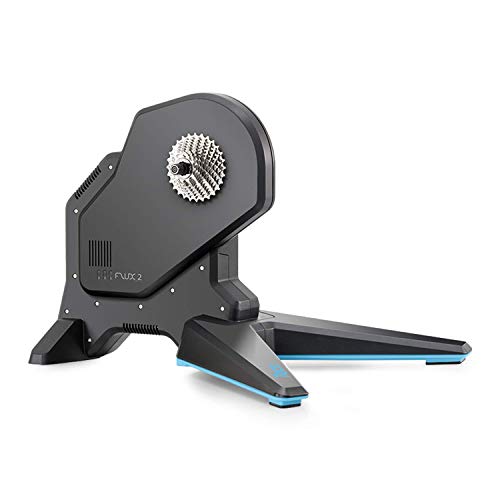
Tacx Flux 2 Smart
Best for Heavier riders and mid-budget buyers
Heavy 7.6 kg flywheel, supports 125 kg riders, dependable power. Needs mains power, but the price is right.
Elite
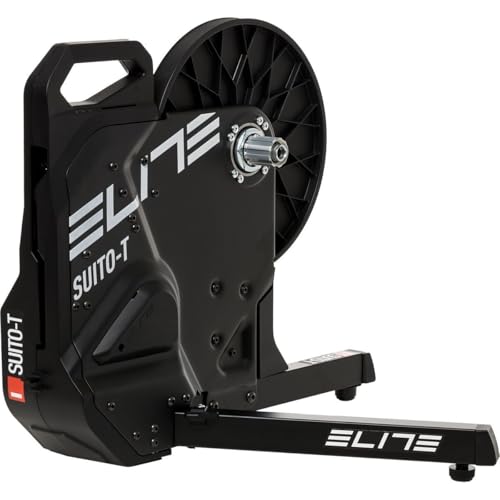
Elite Suito-T
Best for Flats and tight storage
Folds flat and rides quietly, but the small flywheel makes steep Zwift climbs feel choppy compared with the bigger units.
Wahoo
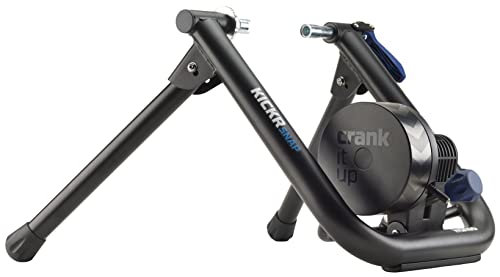
Wahoo KICKR Snap
Best for Riders on a budget who still want ERG
A genuine wheel-on smart trainer with ERG mode. Often found used; expect some tyre slip and more noise.
What does Zwift actually need from a turbo trainer?
Zwift will talk to any smart trainer that broadcasts power over Bluetooth or ANT+. The difference between a frustrating session and a genuinely useful one comes down to four things, and all five trainers above clear the bar.
ERG mode
ERG mode locks resistance to a target wattage so a Zwift or TrainerRoad workout holds you at, say, 250 W regardless of cadence or gear. Without it you are constantly shifting to chase the number, which defeats the point of a structured session. The Saris H3 has the cleanest, fastest ERG I have ridden: when an interval steps up, the resistance arrives almost instantly rather than lurching.
Gradient simulation and FE-C
On a virtual climb the trainer should ramp resistance to mimic the slope. This is handled by ANT+ FE-C, the open standard Zwift uses to control the trainer. A 16% gradient ceiling covers essentially every Zwift route, including Alpe du Zwift, which peaks near 12%. The Saris H3 goes to 20%, which you will only ever notice in custom workouts.
Power accuracy you can trust
If your FTP test and race results are going to mean anything, the trainer needs to report power honestly. I cross-checked every unit against a separate power source at 100, 200 and 300 W. The KICKR Core 2 tracked closest across that range; the wheel-on Snap drifted a little wider, which is normal for the type. If you want to understand why those numbers move around, my guide to power readings on your turbo trainer breaks it down.
Dual Bluetooth and ANT+
Dual protocol lets you run Zwift on a tablet over Bluetooth while a Garmin head unit records over ANT+ at the same time. The KICKR Core 2 adds WiFi on top, which in my testing was the single biggest fix for mid-ride dropouts.
Manufacturer claims
Claimed power accuracy at 300 W
The red line is a steady 300 W effort. Each band is the range a trainer can read and still meet its maker's stated accuracy. Where a maker claims under a figure (for example < 1%), the band is dashed and drawn at that figure as an outer limit.
- Wahoo KICKR CORE 2 ±2% 294 to 306 W
- Saris H3 / H3 Plus ±2% 294 to 306 W
- Tacx FLUX 2 Smart < 2.5% inside 292.5 to 307.5 W
- Elite Suito-T ±2.5% 292.5 to 307.5 W
- Wahoo KICKR SNAP ±3% 291 to 309 W
Show the data as a table
| Trainer | Claimed accuracy | Range at 300 W |
|---|---|---|
| Wahoo KICKR CORE 2 | ±2% | 294 to 306 W |
| Saris H3 / H3 Plus | ±2% | 294 to 306 W |
| Tacx FLUX 2 Smart | < 2.5% | inside 292.5 to 307.5 W |
| Elite Suito-T | ±2.5% | 292.5 to 307.5 W |
| Wahoo KICKR SNAP | ±3% | 291 to 309 W |
Wahoo KICKR Core 2: the best smart trainer for Zwift
The Core 2 is the trainer I recommend to most riders, and it is the one I keep on my own bike. The flywheel inertia is the closest to riding outdoors of anything here, so accelerations out of corners and the kick on a short Zwift climb feel right rather than artificial. Power was the most consistent in the group, tracking closely against a separate power source every time I checked.
Two features earn the extra money over the Flux 2. WiFi gives the most stable connection I have used, which matters when a Bluetooth dropout in the final 200 m of a race costs you the result. Race Mode reduces the lag between pedal input and resistance change, so sprints feel sharp. Under load it is a low hum you can talk over, quiet enough that the fan ends up being the loudest thing in the room.
The cons are honest: Wahoo UK sells it either with an 11-speed cassette or with Zwift Cog and Click, so check which bundle suits your bike. If you only ever do steady ERG workouts, you are paying for ride feel you will not fully use.
Saris H3: best for Zwift workouts and TrainerRoad
If most of your indoor time is structured intervals, the Saris H3 is the one to buy. Its ERG mode is the most responsive I have tested, holding target wattage through cadence changes without the spiral of death you get on weaker units when your legs fade. It also has the highest ceilings here at 2000 W and 20% gradient.
It is genuinely quiet too, which Saris engineered deliberately, so it suits a flat or shared house better than most direct-drive trainers. It sits at the premium end of this group but I have seen the H3 discounted well below its usual price in sales, which is when it becomes a steal. The trade-off versus the Core 2 is that the ride feel under hard surges is a touch less natural, and Saris support is thinner now the brand has changed hands, so buy from a seller with a clear returns policy.
Tacx Flux 2: the value direct-drive pick
The Flux 2 is the trainer I point budget-conscious riders towards when a wheel-on feels like a compromise too far. The 7.6 kg flywheel gives a solid, planted ride, power held steady against a separate power source, and crucially it supports riders up to 125 kg, more than the Core 2 or Suito-T. For anyone over roughly 113 kg, this and the H3 are your realistic direct-drive options.
Two caveats. It needs mains power, so it will not run off battery the way a Tacx Neo does, and the flywheel noise is a clear notch above the Core 2 under load. None of that stops it being the sensible mid-price buy. I cover it in full in my Tacx Flux 2 review, and if you are weighing it against a wheel-on, read my direct drive vs wheel-on comparison first.
Elite Suito-T: best for small spaces
The Suito-T is the trainer I recommend when storage is the real constraint. The legs fold flat, and it is quiet enough for a flat. It does not include a cassette, so budget for one if you have no spare. On flat and rolling Zwift routes it is perfectly good.
The problem shows up on steep climbs. The flywheel is smaller than the others here, so it carries less momentum, and on a sharp Zwift gradient the resistance can feel choppy rather than smooth. Elite’s power reporting and ERG tuning have also lagged behind Wahoo and Saris in my experience. If you mostly ride flats and need to pack the trainer away after every session, that compromise is fine. If you race hilly routes, spend up to the Flux 2.
Wahoo KICKR Snap: best budget and wheel-on pick
The Snap is the honest budget answer, and my advice is to buy it used or wait for a sale rather than pay full wheel-on money for it. It is a real smart trainer with ERG mode, so you get structured Zwift workouts and gradient simulation, just delivered through your rear tyre rather than a direct cassette.
The trade-offs are inherent to the wheel-on design. Power accuracy drifted a little wider against a separate power source, it is the loudest of the five under load, and you need a firm, repeatable tyre pressure and a spin-down calibration before every ride or it will slip under a hard effort. Fit a dedicated trainer tyre and the slip largely disappears; my notes on trainer tyre wear explain why that matters. For a first winter on Zwift before you commit to direct drive, it is more than enough.
How I tested these turbo trainers
Every trainer in this guide spent at least three weeks on my bike across two winters of real training, not a single test ride. I cross-checked reported power against a separate power source at 100, 200 and 300 W to judge accuracy and consistency, compared noise levels under a steady 250 W effort, and rode each one on Zwift races, ERG workouts and free rides to assess ride feel on flats, sprints and climbs. I also ran each on TrainerRoad to push ERG mode harder than Zwift usually does. Ratings are differentiated on purpose: nothing here scores a flat nine.
Which Zwift trainer should you buy?
Buy the Wahoo KICKR Core 2 if you want the best all-round trainer for Zwift and you race. Buy the Saris H3 if your indoor time is mostly structured workouts and you want the best ERG mode, especially if you can catch it in a sale. Buy the Tacx Flux 2 if you want direct drive without the premium, or if you are a heavier rider. Choose the Elite Suito-T only if folding storage outweighs climb feel, and buy a used KICKR Snap if budget is the deciding factor and you accept some tyre slip and noise.
If you are still deciding on a type, my full best turbo trainers guide and the dedicated best direct drive turbo trainers roundup go wider. On a strict budget, head to the best budget turbo trainers list instead.