Buying Guides
Best Budget Turbo Trainers UK 2026
The short answer
- The BDBikes Magnetic Trainer is the best budget turbo trainer for most first-timers: simple, reliable, and cheap enough that a season of indoor riding is a low-risk experiment.
- If you want app control and power data on a budget, do not buy a new entry-level smart unit: buy a used Wahoo KICKR Snap instead.
- Magnetic trainers (BDBikes, Velo Pro, Tesla 3 Riva) are loud and have no power meter. That is the trade-off for their low price.
- The Elite Novo Force is the pick if you want a few more resistance levels and a slightly better build, though it costs more than the no-name magnetic units.
- Spend your money on the trainer first and a trainer tyre second. Do not waste it on bundled extras you will not use.
The best budget turbo trainer in the UK for most people is the BDBikes Magnetic Trainer: it is cheap, reliable, and low-risk for a first winter indoors. If you want power data and proper Zwift control on a tight budget, do not buy a new entry-level smart trainer, buy a used Wahoo KICKR Snap instead. The other magnetic units here, the Velo Pro and Tesla 3 Riva, are fine for warm-ups but offer nothing the BDBikes does not.
Every winter a flood of club riders ask me the same question: what is the cheapest sensible way to start riding indoors? These are the trainers I actually point them towards, ranked after putting each one through real sessions rather than a quick spin in a shop.
Best budget turbo trainers at a glance
| Trainer | Type | Resistance | Power data | Noise |
|---|---|---|---|---|
| BDBikes Magnetic | Magnetic wheel-on | 6 levels | No | Loud |
| Velo Pro Magnetic | Magnetic wheel-on | 5 levels | No | Loud |
| Tesla 3 Riva Sport | Magnetic wheel-on | 7 levels | No | Loud |
| Elite Novo Force | Magnetic wheel-on | Elastogel, fixed | No | Slightly quieter |
| Wahoo KICKR Snap (used) | Smart wheel-on | Electromagnetic | Yes (+/-3%) | Moderate |
The picks
BDBikes
No manufacturer photo available
BDBikes
BDBikes Magnetic Trainer
Best for First trainer, casual winter fitness
A 12-magnet, 6-level wheel-on unit with a handlebar resistance lever and a riser block. The honest answer to 'what is the cheapest sensible trainer'.
No manufacturer photo available
Velo Pro Magnetic Trainer
Best for Race warm-ups, occasional short sessions
A budget magnetic wheel-on that does exactly what it says. Basic, loud, no surprises. Fine as a backup or warm-up unit.
No manufacturer photo available
Tesla 3 Riva Sport Trainer
Best for Riders who want more resistance steps
Seven resistance levels and a sturdier clamp than most no-name units. Still magnetic, still loud, still no power, but a touch more usable.

Elite
Elite Novo Force
Best for A slightly better build from a real brand
Elastogel roller for quieter, smoother contact and an Italian brand with parts support. It costs more than the no-names, but you feel where the money went.
Wahoo
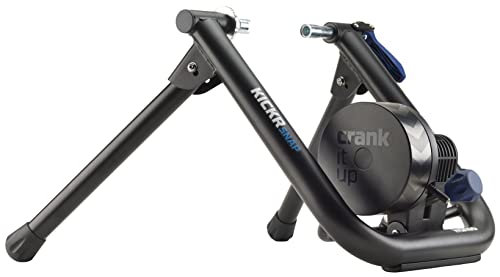
Wahoo KICKR Snap (used)
Best for Zwift and structured training on a budget
The smart trainer to look for second-hand. Electromagnetic resistance, ERG mode, a 4.8 kg flywheel and a claimed +/- 3% power accuracy.
1. BDBikes Magnetic Trainer: the best budget turbo trainer
This is the trainer I hand to beginner cyclists every autumn, and it has earned that spot. For the price you get a 12-magnet resistance unit with six levels controlled by a handlebar lever, a folding frame, a front-wheel riser block and a trainer skewer in the box. There are no hidden extras on day one, which matters more than it sounds at this price.
The thing that separates the BDBikes from the truly nasty bargain-bin units is the magnet count. A 4-magnet trainer produces a cogged, uneven pull you can feel through the pedals at low cadence. The BDBikes 12-magnet unit smooths that out considerably. It is not a fluid trainer and it never pretends to be, but the load at levels 5 and 6 is genuinely useful for a threshold effort, and levels 2 and 3 are right for base endurance off heart rate or perceived effort.
The honest cons: it is loud, comparable to other budget magnetic units, the resistance steps are not linear (4 to 5 is a bigger jump than 1 to 2), and the rear tyre wears, so budget for a trainer tyre if you use it regularly. None of that is a dealbreaker at this price. Read the full BDBikes turbo trainer review for the detail.
2. Velo Pro and 3. Tesla 3 Riva Sport: the no-name magnetic options
These two sit alongside the BDBikes as classic cheap magnetic wheel-on units, and I am grouping them honestly because they are more similar than different. Both clamp to the rear axle, both use a handlebar resistance lever, both are loud in the way every budget magnetic unit is, and neither has any smart features or power measurement.
The Velo Pro is the most basic of the three, priced a little above the BDBikes. It is fine for race-day warm-ups or the occasional short spin, but the resistance feel is a little coarser than the BDBikes and there is nothing it does better. The Tesla 3 Riva Sport is the cheaper of the pair: it has seven resistance levels rather than five or six, and the clamp feels a touch more solid, though it sits a notch below the BDBikes overall. If you can find it cheap, it is a reasonable alternative. Otherwise the BDBikes is the safer first buy.
4. Elite Novo Force: the budget brand pick
The Elite Novo Force is a step up in build and in price. The headline difference is the Elastogel roller, which is softer against the tyre than a hard steel roller. In practice that means slightly less tyre wear, a marginally quieter contact than the no-name units and a smoother feel at steady efforts.
You are also buying a real brand with spare parts and a clamp mechanism that holds the bike securely with less fiddling. It is still a magnetic wheel-on with no power data, so do not expect Zwift control. But if you have outgrown the idea of a bargain-bin throwaway and want something that will survive several winters without feeling cheap, the Novo Force is the sensible budget brand choice.
5. Wahoo KICKR Snap (used): the value play that beats them all
Here is the recommendation that saves people the most money. If what you actually want is Zwift, ERG mode and power data, do not buy a new entry-level smart trainer. A new KICKR Snap costs significantly more, and a new budget smart unit gives you the worst of both worlds: smart-trainer money for compromised accuracy and feel. Instead, buy a used Wahoo KICKR Snap.
I have coached athletes through calibration on the Snap and ridden it enough myself to trust it. The electromagnetic resistance responds to Zwift gradients almost instantly, with none of the lag you get on a magnetic unit. The 4.8 kg flywheel gives a convincing inertia at low cadence, and once you have run a spindown calibration in the Wahoo app, power tracks within roughly 3% at moderate efforts. Above threshold the accuracy drifts a little and the frame vibrates above about 100 rpm, but for the money those are easy compromises.
Manufacturer claims
Budget smart vs step-up direct drive: claimed accuracy
The red line is a steady 300 W effort. Each band is the range a trainer can read and still meet its maker's stated accuracy. Where a maker claims under a figure (for example < 1%), the band is dashed and drawn at that figure as an outer limit.
- Tacx FLUX 2 Smart < 2.5% inside 292.5 to 307.5 W
- Wahoo KICKR SNAP ±3% 291 to 309 W
Show the data as a table
| Trainer | Claimed accuracy | Range at 300 W |
|---|---|---|
| Tacx FLUX 2 Smart | < 2.5% | inside 292.5 to 307.5 W |
| Wahoo KICKR SNAP | ±3% | 291 to 309 W |
Snaps come up regularly on Facebook Marketplace and eBay because riders upgrade to direct drive. Check that the seller can confirm it powers up and pairs over Bluetooth, and run a spindown before your first real session.
Magnetic, fluid or smart on a budget?
For a clear breakdown of how these trainer types differ, see my guide to direct drive vs wheel-on turbo trainers. The short version for budget buyers:
- Magnetic (BDBikes, Velo Pro, Tesla 3 Riva): cheapest, loudest, no power. Best for first-timers and warm-ups.
- Elastogel magnetic (Elite Novo Force): a little quieter and smoother, brand support, mid-budget.
- Used smart (KICKR Snap): the value sweet spot if you want power and Zwift. Costs more upfront but does far more.
Where to spend your budget
If your budget is tight, buy the BDBikes and a trainer tyre, and put a trainer mat under it to protect your floor and cut a little noise. If you genuinely want power and Zwift, save a bit longer or shop used and get the KICKR Snap. The one path I would steer you away from is spending on a brand new budget smart trainer: for a smart trainer, used is always the smarter buy.
If you have a firm price ceiling, I have broken the picks down further by budget: see the best turbo trainers under £100 and the best turbo trainers under £200.