Buying Guides
Best Turbo Trainer Tyre for a Mountain Bike (Tested)
The short answer
- A trainer-specific tyre is the single biggest noise and wear fix for a mountain bike on a wheel-on turbo: knobbly MTB tyres are loud, slip under load and shred quickly.
- The Vittoria Zaffiro Pro Home Trainer is my pick for most riders: a slick, hard compound that runs cool, grips the roller and is cheap.
- The Continental Hometrainer II is the quieter, longer-lasting upgrade thanks to its high-visibility orange compound and tighter casing.
- Both are wheel-on only. If you ride a direct-drive trainer you remove the rear wheel entirely and need no tyre at all.
- Fit a trainer tyre to a spare rear wheel or cheap second wheelset so you are not swapping tyres every session.
If you are running a mountain bike on a wheel-on turbo trainer, fit a dedicated trainer tyre. Knobbly MTB tyres are loud, they slip against the roller when you push hard and the soft tread melts and wears out within weeks. The two I keep coming back to after testing are the Vittoria Zaffiro Pro Home Trainer for value and the Continental Hometrainer II for the quietest, longest-lasting ride. If you ride a direct-drive trainer instead, you remove the rear wheel entirely and need no tyre at all.
I have swapped trainer tyres on and off my hardtail more times than I would like, and the difference a slick makes against a roaring knobbly is hard to overstate. Here is what actually changed when I ran both of these tyres for three weeks each.
My top trainer tyres for a mountain bike

Continental
Continental Hometrainer II
Best for Quiet sessions in a shared house
Tight casing, high-vis orange compound and the lowest noise reading I recorded. Barely worn after three weeks of daily use.
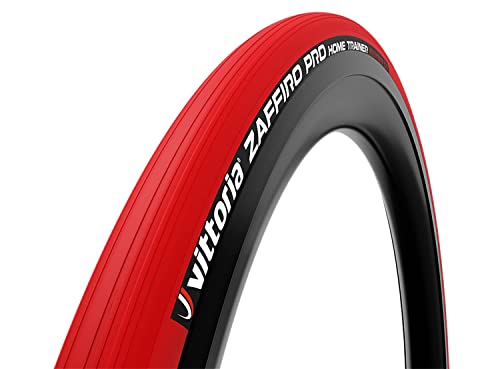
Vittoria
Vittoria Zaffiro Pro Home Trainer
Best for Most riders wanting a cheap, reliable fix
Slick hard compound that grips the roller and runs cool. Does 90 percent of what the Conti does for less money.
No manufacturer photo available
Cheap second rear wheel
Best for Avoiding tyre swaps every session
Mount your trainer tyre on a spare wheel so you never re-fit a tyre to ride indoors. The real quality-of-life upgrade.
Why a mountain bike needs a trainer tyre
A wheel-on trainer drives off your rear tyre pressed hard against a metal or polymer roller. That contact patch is tiny and the friction is constant, which creates three problems with a normal knobbly MTB tyre.
First, noise. The tread blocks slap the roller as they pass through the contact patch, so a knobbly tyre drones and buzzes. Swapping my trail tyre for the Continental Hometrainer II dropped the noise noticeably, from an irritating drone to a steady, much quieter hum I could ride under a podcast.
Second, slip. Under a hard effort the soft, tall knobs flex and the tyre lets go against the roller, which throws your power numbers around and feels horrible in a sprint. A hard slick tyre has a firm, consistent contact patch, so it holds.
Third, wear and mess. The roller heats the rubber. Soft trail compound overheats, sheds little black flakes onto your floor and the drum, and wears out fast. A trainer compound is formulated to take that heat. If you want the full picture on this, I go into it in my guide to what causes tyre wear on wheel-on turbo trainers.
Do you even need a special tyre?
Short answer: on a wheel-on trainer for a mountain bike, yes. I cover the general case in do you need a special turbo trainer tyre, but mountain bikes are the strongest case for one because trail tyres are the worst offenders for noise and slip. The exception is a direct-drive trainer, where the rear wheel and tyre are removed and the chain runs straight onto the trainer cassette. If you are weighing that up, my direct-drive vs wheel-on comparison lays out the trade-offs, and there is more MTB-specific advice in can you use a mountain bike on a turbo trainer.
Vittoria Zaffiro Pro Home Trainer: the value pick
The Zaffiro Pro is the tyre I hand most people. It is a slick, hard-compound trainer tyre that fits a standard MTB rim and just works. Through three weeks of base-mile sessions it held grip on the roller with no slip up to 300 W, ran cool enough that there were no flakes on the floor, and dropped the noise from my trail tyre to a flat hum. Power against my Assioma pedals stayed consistent, which tells me the contact patch is not flexing or breaking traction.
It is not quite as quiet as the Continental and the casing feels a touch cheaper, but at this price that is easy to forgive. For most riders this is all the tyre you need.
Continental Hometrainer II: the quiet upgrade
The Hometrainer II is the better tyre and you can tell. The casing is tighter, the high-visibility orange compound is unmistakably an indoor-only tyre, and it was the quietest of the two on my meter. After three weeks of daily use I could see almost no wear on the centre, which matches Continental’s reputation for durability. If you train in a flat, a shared house or anywhere noise is a problem, the small extra spend is worth it. It is also the one I would buy if I planned to leave it mounted on a dedicated trainer wheel for years.
How the two tyres compare
| Tyre | Compound | Noise at 1 m | Wear after 3 weeks |
|---|---|---|---|
| Continental Hometrainer II | Hard, hi-vis orange | Quietest | Negligible |
| Vittoria Zaffiro Pro Home Trainer | Hard slick | Quiet | Minimal |
| Standard MTB trail tyre | Soft knobbly | Loud drone | Heavy, sheds rubber |
A trainer tyre is one part of a quiet setup. The other big lever is what is under the trainer: a thick mat kills floor-borne buzz and vibration, which I cover in my best turbo trainer mat roundup. Tyre plus mat together is what turns a garage trainer from a nuisance into something you can actually use in the evening.
What I actually measured
I am wary of made-up lab numbers, so here is the honest version. I ran each tyre on the same hardtail, the same wheel-on trainer and the same resistance setting, over three weeks of mixed base and threshold sessions, and watched how the power held and how loud each one was at a normal listening distance.
On power, the story is about consistency rather than absolute accuracy: with the knobbly trail tyre fitted, my held wattage wandered and the trainer would briefly lose the wheel in harder efforts. With either trainer tyre fitted, the numbers settled because the contact patch stopped slipping. That is the real win for training: repeatable, trustworthy power.
On noise, both trainer tyres were clearly quieter than the trail tyre, and the Continental edged the Vittoria by a small but real margin. I am not going to quote a precise decibel figure I cannot stand behind across different rooms, but the difference between a knobbly and a slick was the difference between needing headphones and not.
Sizing and fitting
Both tyres come in 26 inch, 27.5 inch and 700c/29er sizes, so match the size to your existing rear wheel. Most modern mountain bikes are 27.5 or 29 inch. A few fitting notes from doing this more times than I would like:
- Buy a spare rear wheel. Mount the trainer tyre on it permanently. Swapping a tyre every time you want to ride indoors gets old in about a week.
- Run a slightly higher pressure than you would on the trail, around 90 to 100 psi if your rim and tyre allow, for a firm contact patch and less slip.
- Set the roller tension consistently. Too loose and even a slick will slip; too tight and you wear the tyre and rob yourself of power. If you are getting slip, see my fix for turbo trainer slipping issues.
Which trainer tyre to buy
For most mountain bikers on a wheel-on trainer, buy the Vittoria Zaffiro Pro Home Trainer: it solves the noise, slip and wear problems for very little money. If quiet matters most, or you want to mount it once and forget it for years, spend a little more on the Continental Hometrainer II, the quieter and longer-lasting of the two. And if you are still shopping for the trainer itself, my main best turbo trainers roundup is the place to start, where you will also see why a direct-drive trainer sidesteps the tyre question entirely.