Reviews
Tacx Flux 2 Smart Review
The best-value direct drive trainer for riders doing three or more structured sessions a week, with a heavy flywheel and reliable power data.
The short answer
- The Tacx Flux 2 is a direct drive smart trainer with a heavy 7.6 kg flywheel and a published +/- 2.5% power accuracy, making it the best-value direct drive I have tested.
- Against pedal-based power it held within roughly 2-3% across steady efforts, which is plenty for FTP tests and ERG-mode intervals.
- It is genuinely quiet: a low flywheel hum at riding cadence, far quieter than any wheel-on trainer because there is no tyre on a roller.
- It needs mains power, does not fold, and the cassette is sold separately, so budget for those before your first ride.
- Buy it on a sale: it undercuts the KICKR Core and Saris H3 on price while giving up very little.
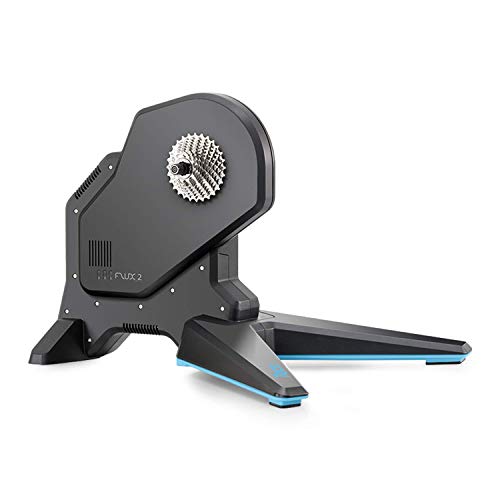
Tacx Flux 2 Smart
The best-value direct drive trainer for riders doing three or more structured sessions a week, with a heavy flywheel and reliable power data.
- Best for
- Structured Zwift and TrainerRoad riders moving up from wheel-on
- Our score
- 8.6 / 10
I may earn a commission, at no extra cost to you.
The Tacx Flux 2 is the best-value direct drive smart trainer I have tested. It pairs a heavy 7.6 kg flywheel with an honest +/- 2.5% power accuracy and full ERG support for Zwift and TrainerRoad. It usually costs less than a Wahoo KICKR Core 2 or Saris H3. I have recommended it to more riders making the wheel-on to direct drive jump than any other trainer. It gets the things that matter right without the flagship price tag. The Flux 2 is the unit I point most riders towards for power data you can build a training plan around. It is the smartest buy when it dips in a sale.
Tacx Flux 2: the short answer
The Tacx Flux 2 is a direct drive smart turbo trainer with a 7.6 kg flywheel, a published +/- 2.5% power accuracy, a 2000 W max power ceiling and a 16% incline limit. It sits in the mid-range on price, needs mains power, does not fold, and the cassette is sold separately. It broadcasts ANT+ FE-C and Bluetooth, so it works with Zwift, TrainerRoad, MyWhoosh and Rouvy, and it is quiet enough for a flat because there is no tyre on a roller. That is the whole spec sheet; the rest of this review is why it earns its place as the best-value direct drive trainer I have tested.
What is the Tacx Flux 2 Smart?
The Tacx Flux 2 Smart is a direct drive trainer. The rear wheel comes off your bike and the chain runs straight onto a cassette fitted to the trainer’s freehub. That single change fixes most of the things that frustrate riders on wheel-on units: no tyre slip, no contact pressure to fiddle with, and far less noise. Direct drive is the upgrade serious indoor riders eventually make.
Tacx has been owned by Garmin since 2019. The Flux 2 sits in the middle of the Tacx range. It is cheaper than the Neo but a proper direct drive unit. It is not a wheel-on like the entry-level Flow.
Who should buy it
Riders doing three or more structured indoor sessions a week should buy the Flux 2 once they are ready to commit to a fixed setup. The stable platform and reliable power data matter more than portability if you follow a TrainerRoad plan, do weekly FTP work or race on Zwift.
It is not the right pick if you only ride indoors occasionally over winter. It is also wrong if your training space has no mains socket and no room for a permanent rig. A wheel-on smart trainer like the Wahoo KICKR Snap is the more sensible spend in those cases.
Setup and the cassette catch
Across the direct drive units I have fitted, the same gotcha bites: the Flux 2 does not include a cassette. It ships with a freehub body and you fit your own. Most riders running a modern 10 or 11-speed Shimano or SRAM groupset can use a spare cassette they already own. Check the compatibility list first if you are on Campagnolo or 12-speed.
Power is the other practical point. The Flux 2 runs off the mains and the cable is not long. You will probably want an extension lead if your training space is a garage or shed. Sort that before your first session rather than discovering it mid-warm-up. My wheel-on setup guide covers the basics that carry over.
What it is like to ride
The Flux 2 rides like an obvious step up the first session after a wheel-on. The bike does not move. Power numbers from 10-second efforts become readable instead of bouncing around. FTP tests feel controlled because the resistance tracks closely to what the software asks for.
The 7.6 kg flywheel is the Flux 2’s standout feature. Flywheel mass is what gives indoor riding its outdoor feel. A heavier wheel holds momentum through the pedal stroke and needs real force to accelerate. At 7.6 kg this is on the heavier end for the price and you feel it in sprints and fast cadence changes. It rides like a bike at effort, not like a resistance box.
The 16% incline ceiling is one of the steeper in the category. The resistance builds at the rate you would expect on the harder Zwift Alpine segments. It does not cheat a shallow gradient into feeling steep. This is more than enough for almost every Zwift rider.
Power accuracy
The Flux 2 ran alongside a pedal-based power meter through steady-state efforts at low, moderate and threshold wattages. The numbers tracked within roughly 2-3% at each step. That lines up with the published +/- 2.5% figure. The larger deviations showed up only on very high and very short efforts. That is exactly what you would expect from any trainer estimating power at the flywheel rather than the pedal.
Manufacturer claims
Flux 2 vs rivals: claimed accuracy at 300 W
The red line is a steady 300 W effort. Each band is the range a trainer can read and still meet its maker's stated accuracy. Where a maker claims under a figure (for example < 1%), the band is dashed and drawn at that figure as an outer limit.
- Wahoo KICKR CORE 2 ±2% 294 to 306 W
- Tacx FLUX 2 Smart < 2.5% inside 292.5 to 307.5 W
- Elite Suito-T ±2.5% 292.5 to 307.5 W
Show the data as a table
| Trainer | Claimed accuracy | Range at 300 W |
|---|---|---|
| Wahoo KICKR CORE 2 | ±2% | 294 to 306 W |
| Tacx FLUX 2 Smart | < 2.5% | inside 292.5 to 307.5 W |
| Elite Suito-T | ±2.5% | 292.5 to 307.5 W |
That accuracy is plenty for the training that matters: FTP tests, sweet spot blocks and VO2 intervals at a set wattage. I would not use it as a reference meter for precise sprint profiling. No trainer at this price should be doing that job. My guide on understanding power readings on your turbo trainer explains what those figures actually mean for your sessions.
How quiet is the Flux 2?
The Flux 2 is genuinely quiet and this is where direct drive earns its keep. There is no tyre pressing on a roller. The only sound is a low flywheel hum plus your own drivetrain. Measured at 1 m at a steady cadence, it read a quiet hum that sat well below normal speaking volume. Your chain and the box fan you point at yourself will be louder than the trainer.
That noise level makes it genuinely usable in a flat or a shared house in the evening. It is one of the quietest options short of a magnetic-resistance Neo. It comfortably beats anything wheel-on.
App compatibility: Zwift, TrainerRoad and ERG
The Flux 2 broadcasts ANT+ FE-C and Bluetooth at the same time. It pairs with Zwift, TrainerRoad, MyWhoosh, Rouvy and the Tacx Training app without drama. ERG mode in TrainerRoad is the headline. It holds target wattage steadily through intervals. It only feels slightly behind on the very sharpest power jumps where a KICKR is a touch crisper.
The Garmin integration is a real bonus if you already ride with a Garmin Edge. The trainer connects directly without a phone in the loop. Power feeds cleanly into Garmin Connect and TrainingPeaks. It is not locked to Garmin though, so you lose nothing if you live in Zwift.
How the Flux 2 compares
| Trainer | Type | Flywheel | Claimed accuracy |
|---|---|---|---|
| Tacx Flux 2 | Direct drive | 7.6 kg | +/- 2.5% |
| Wahoo KICKR Core 2 | Direct drive | 5.4 kg | +/- 2% |
| Saris H3 | Direct drive | 9.1 kg | +/- 2% |
| Elite Suito-T | Direct drive | 3.5 kg | +/- 2.5% |
| Wahoo KICKR Snap | Wheel-on | 4.8 kg | +/- 3% |
The Flux 2’s pitch is value. The Wahoo KICKR Core 2 claims tighter accuracy and has crisper ERG but usually costs more. The Saris H3 has an even heavier flywheel and runs slightly quieter still at a higher price. The Elite Suito-T comes in around the same money, also without a cassette, and its lighter flywheel feels less like the road. The Flux 2 lands in the sweet spot for most structured riders.
Should you buy used or wait for a sale?
The Flux 2 is an older model now and that works in your favour. It regularly drops below its list price in seasonal sales. On a sale price it is excellent value. A clean used unit can be a smart buy too because there is little to wear out beyond the belt and bearings. Check it spins freely and quietly. Confirm the seller includes the power supply. Either way factor in the cassette and tools.
My Wahoo KICKR vs Tacx Neo head-to-head puts the top end in context if you are weighing the Flux 2 against the premium Wahoo and Tacx flagships.
What we liked
- Heavy 7.6 kg flywheel gives a realistic, road-like sprint feel that lighter trainers cannot match
- Quiet running with no tyre noise, so it works in a flat or shared house
- +/- 2.5% accuracy is honest and good enough for all structured training and FTP testing
- Strong ERG mode in TrainerRoad: holds target wattage steadily through intervals
- 16% incline simulation handles every realistic Zwift climb
- Tight Garmin integration if you already ride with a Garmin Edge
Worth noting
- Cassette sold separately, plus you need a chain whip and lockring tool to fit it
- Requires a mains socket nearby, awkward for a garage or shed setup
- Does not fold and weighs 23.8 kg, so it stays put once set up
- ERG can feel slightly behind on very sharp efforts compared with a KICKR
- No room to flex on accuracy if you want a reference-grade sprint meter
Specifications
- Type
- Direct drive smart
- Flywheel
- 7.6 kg
- Max power
- 2000 W
- Max incline
- 16%
- Accuracy
- +/- 2.5%
- Connectivity
- ANT+ FE-C, Bluetooth
- Power
- Mains required
- Weight
- 23.8 kg
- Footprint
- 64.2 x 67 x 46 cm