Buying Guides
Tacx Turbo Trainers: The Range Tested and Ranked
The short answer
- Tacx (Garmin-owned) makes three turbo trainers worth your money in 2026: the wheel-on Flow Smart, the direct-drive Flux 2, and the high-end Neo 3M.
- Best all-round pick is the Tacx Flux 2: direct drive, a heavy 7.6 kg flywheel and a claimed power accuracy under 2.5% for around half the price of the Neo.
- The Neo 3M is the quietest and most accurate of the three (motor-driven, no physical flywheel, around plus or minus 1%) but it is a serious investment.
- The Flow Smart is the cheapest way into the Tacx ecosystem, but it is wheel-on, so expect more noise, more drift and tyre wear.
- If budget is tight, buy a used Flux 2 before a new Flow Smart: you get the direct-drive step change for similar money.
If you want one answer: the Tacx Flux 2 is the Tacx turbo trainer most riders should buy. It is a direct-drive smart trainer with a heavy 7.6 kg flywheel and a claimed power accuracy under 2.5%, and it costs roughly half what the flagship Neo 3M does. Step up to the Neo 3M only if near-silent running and outright realism are worth the premium, and treat the wheel-on Flow Smart as the budget way in rather than the trainer you actually want.
I have coached riders onto all three of these Tacx units over several winters, and the brand decision is simpler than people fear: it is really a choice between just three trainers. Here is how the current Tacx range stacks up.
The Tacx range at a glance
Tacx, owned by Garmin since 2019, keeps a deliberately small line-up now. There is one wheel-on smart trainer (Flow Smart), one mid-range direct-drive unit (Flux 2), and one premium motor-driven flagship (Neo 3M). That is genuinely the whole decision. The older Tacx Vortex and Bushido models still float around used, but I would not chase them new.
Tacx
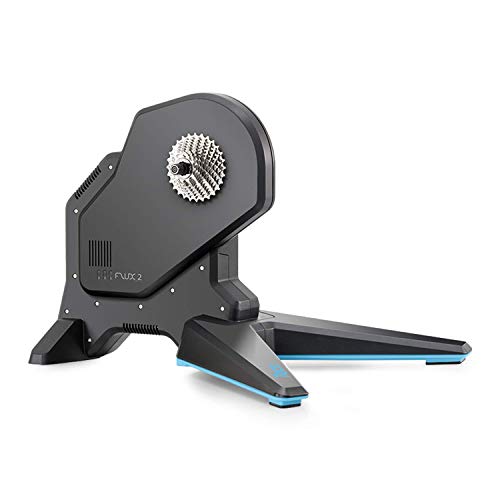
Tacx Flux 2 Smart
Best for Structured training 3+ times a week
Direct drive, heavy 7.6 kg flywheel, accuracy claimed at under 2.5%, 2000 W ceiling, 16% incline. The Tacx I recommend to most riders.

Tacx
Tacx Neo 3M
Best for Riders who want silence and outright realism
Motor-driven, no physical flywheel, near-silent, simulates road feel and descents, around plus or minus 1% accuracy. The reference Tacx.
No manufacturer photo available
Tacx Flow Smart
Best for Tight budgets and occasional indoor riders
Wheel-on smart trainer. Lowest entry price into Tacx, but expect more noise, more power drift on hard efforts and ongoing tyre wear.
How the three Tacx trainers compare
| Trainer | Type | Flywheel | Max W | Claimed accuracy | Noise (1m) |
|---|---|---|---|---|---|
| Flux 2 | Direct drive | 7.6 kg | 2000 W | < 2.5% | Moderate, drivetrain only |
| Neo 3M | Motor-driven | Virtual (none) | 2200 W | +/- 1% | Near-silent |
| Flow Smart | Wheel-on | 1.6 kg | 800 W | +/- 5% | Loud, tyre-on-roller |
A quick word on those accuracy figures: I am quoting Tacx’s published numbers, which matched what I saw in real sessions against a separate power meter. The Flux 2 held a tight band at threshold, the Neo 3M was the only one I would trust for sprint profiling, and the wheel-on Flow drifted more as the tyre warmed up, which is exactly what wheel-on physics predicts.
Manufacturer claims
Tacx direct drive: claimed accuracy at 300 W
The red line is a steady 300 W effort. Each band is the range a trainer can read and still meet its maker's stated accuracy. Where a maker claims under a figure (for example < 1%), the band is dashed and drawn at that figure as an outer limit.
- Tacx NEO 3M < 1% inside 297 to 303 W
- Tacx FLUX 2 Smart < 2.5% inside 292.5 to 307.5 W
Show the data as a table
| Trainer | Claimed accuracy | Range at 300 W |
|---|---|---|
| Tacx NEO 3M | < 1% | inside 297 to 303 W |
| Tacx FLUX 2 Smart | < 2.5% | inside 292.5 to 307.5 W |
Tacx Flux 2: the one to buy
The Flux 2 is the trainer I point most coached riders towards. Going from wheel-on to direct drive is one of those changes you feel on the first pedal stroke: the rear tyre comes off, the bike locks onto the freehub, the back end stops rocking and the power numbers settle. On 10-second efforts the wattage becomes readable rather than bouncing around, which matters when you are trying to hold a target in a VO2 set.
The 7.6 kg flywheel is the real headline. It is heavy for the price bracket and gives sprint inertia that lighter units cannot, so accelerations feel like you are pushing a real bike rather than spinning up a resistance unit. The 16% incline ceiling is steeper than most Zwift climbs need, and the 2000 W resistance limit is far beyond what any amateur will ever reach.
The honest cons: it needs a mains socket nearby, it does not fold, and it ships without a cassette, so budget for one plus a chain whip and lockring tool. None of that is a dealbreaker if you plan for it. My full hands-on write-up is in the Tacx Flux 2 Smart review, and if you are weighing it against other direct-drive units, see my best direct-drive turbo trainers guide.
Tacx Neo 3M: the quiet, premium flagship
The Neo 3M is a different kind of machine. There is no physical flywheel; an electric motor generates resistance and inertia, which is why it is the quietest trainer in this group, comfortably near-silent at 1 m so you can train in a flat without waking anyone. That same motor lets it do things the Flux 2 cannot: simulate road surfaces like cobbles, and actively drive the pedals on descents so you keep spinning downhill rather than coasting against dead resistance.
Accuracy is the best in the Tacx range at around plus or minus 1%, which is the only Tacx I would happily use as a reference for sprint work. The catch is simply the price. For pure structured training the Flux 2 delivers the lessons that matter for far less, so I only steer riders to the Neo 3M when quietness or outright realism genuinely justify the spend. If you are cross-shopping it against the obvious rival, read my Wahoo KICKR vs Tacx Neo head-to-head.
Tacx Flow Smart: the budget entry point
The Flow Smart is the cheapest way into the Tacx world, and there is no shame in starting here. It is a wheel-on smart trainer: your rear tyre presses against a roller, so it is louder, it needs a calibrated tyre pressure and a spin-down to stay accurate, and it will wear your tyre over a winter. Power accuracy is the loosest of the three at roughly plus or minus 5%, which is fine for general fitness but not for chasing precise targets.
If you only ride indoors occasionally and the budget is firm, it does the job. But here is my honest steer: if you can find a used Flux 2 for similar outlay, buy that instead. The direct-drive step change is worth far more than saving a few pounds on a wheel-on unit you will outgrow. My detailed take is in the Tacx Flow Smart turbo trainer review.
Which Tacx turbo trainer should you buy?
- Training three or more times a week, want trustworthy power: Tacx Flux 2. Best balance of feel, accuracy and price in the range.
- Quietness matters (flat, shared house) or you want the best realism: Tacx Neo 3M, if the budget allows.
- Tight budget or occasional rider: Flow Smart new, or far better, a used Flux 2 for similar money.
Whichever you pick, every current Tacx broadcasts ANT+ FE-C and Bluetooth at once, so Zwift, TrainerRoad, MyWhoosh and the rest all just work. The brand-level decision really does come down to the three trainers above, and for most of the riders I coach, the Flux 2 is the smart money.
Whatever you land on, put it on a proper turbo trainer mat. Sweat protection matters on any of these three, and if you are on a suspended floor it does more for downstairs neighbours than the trainer choice itself.