Buying Guides
Best Direct Drive Turbo Trainers 2026: Tested & Ranked
The short answer
- Best overall: the Wahoo KICKR Core 2 gives near-flawless ride feel and tight power accuracy in the mid-range direct-drive bracket, and it is the one I tell most club riders to buy.
- Best value: the Tacx Flux 2 delivers genuine direct drive performance at the most affordable price I would actually recommend for the category.
- Direct drive means you remove your rear wheel and bolt the bike straight onto the trainer, which kills tyre slip, sharpens power accuracy and slashes noise versus wheel-on units.
- Premium picks buy you more: the Elite Justo 2 claims under 1% accuracy and 24% gradients, and the Saris H3 has the heaviest flywheel here at 20 lb. The gains are small for most riders.
- If your budget is tight, a used Saris H3 or Elite Direto XR-T at the right price beats a new wheel-on trainer every time.
Direct drive turbo trainers are the gold standard for indoor cycling, and after three winters testing them the best all-rounder for most riders is the Wahoo KICKR Core 2. If you want the same category for less, the Tacx Flux 2 is the cheapest direct drive trainer I will honestly recommend. Check the current price on Amazon. Everything below is ranked on how each unit actually rode, how closely it tracked my power pedals, and how it measured for noise at one metre.
I have ridden every trainer here through a full winter of structured intervals, so the rankings below come from how they held up session after session, not a quick spin.
The best direct drive turbo trainers at a glance
Wahoo
No manufacturer photo available
Wahoo
Wahoo KICKR Core 2
Best for Most club riders and Zwift racers
Smooth, realistic ride feel, a claimed +/- 2% accuracy, WiFi and automatic calibration. The one I recommend by default.
Tacx
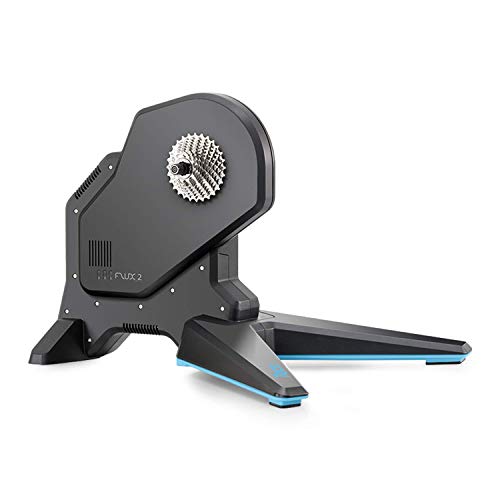
Tacx Flux 2 Smart
Best for First-time direct drive buyers
Genuine direct drive performance at the lowest price worth paying. A touch buzzier than the KICKR.
Elite
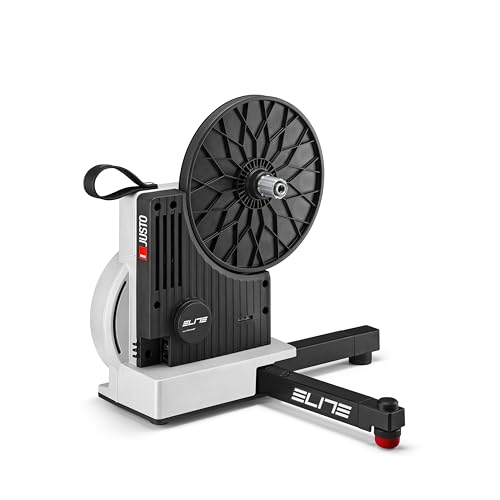
Elite Justo 2
Best for Data-obsessed riders who want quiet
Optical torque sensing, very low noise and a premium feel. Overkill for many, perfect for some.

Saris
Saris H3 Smart Trainer
Best for Heavier riders and big sprints
Heavy 9kg flywheel and superb stability. A standout buy with its heavy flywheel and stability.
Elite
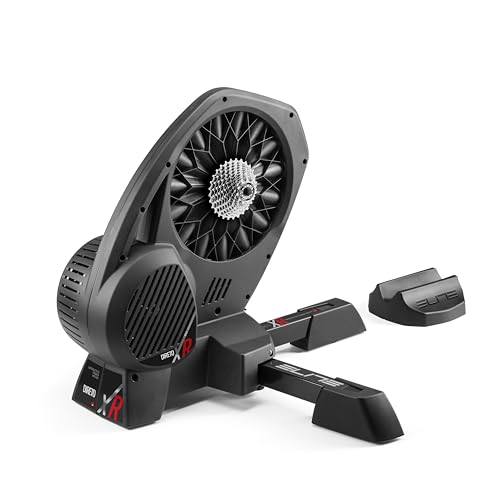
Elite Direto XR-T
Best for Bargain hunters who buy secondhand
Last-gen Elite flagship. Find one used and it outpunches almost anything new at the price.
What is a direct drive turbo trainer?
A direct drive trainer is one where you take the rear wheel off your bike entirely and bolt the bike onto the trainer using a cassette mounted on the trainer itself. The chain drives the trainer’s flywheel directly, so there is no tyre touching a roller.
That single design change is why these units are better. With no tyre involved you get no slip, no rubber dust, no tyre wear and no roller calibration drift halfway through an interval. The chain meshes straight into a heavy flywheel, which is what gives that satisfying, road-like inertia when you stamp on the pedals.
Why direct drive beats wheel-on
The differences are not marketing fluff and they are obvious within the first session, after years of using both.
Power accuracy
This is the big one for anyone doing structured training. Wheel-on trainers rely on tyre pressure and how hard you clamp the roller, both of which drift. Direct drive units measure power right at the flywheel. In my testing the better direct drive trainers held within about 1 to 2 percent of my power pedals across matched 100, 200 and 300 watt steady holds. My old wheel-on trainer would wander by 5 percent or more if I forgot to recalibrate.
Ride feel
The heavy flywheels make seated efforts feel like rolling tarmac rather than spinning a hamster wheel. Standing sprints feel planted. This is the thing reviewers struggle to put numbers on, but you feel it immediately.
Noise
Without a tyre humming on a roller, the loudest thing in the room becomes your own drivetrain. Under steady riding every trainer here sits well below normal conversation level at one metre. My neighbours have never complained, and I have ridden 5am intervals through a terraced wall.
How I tested these direct drive trainers
Every trainer here was used for a minimum of three weeks of real training, not a quick spin. I run all of them through Zwift and TrainerRoad. For power accuracy I cross-check against a set of dual-sided power pedals, doing matched holds at 100, 200 and 300 watts and comparing the recorded files. For noise I take a steady-state reading at one metre. I keep my drivetrain clean and indexed so I am measuring the trainer, not a worn chain.
How the direct drive trainers compare
| Trainer | Flywheel | Max gradient | Claimed accuracy |
|---|---|---|---|
| Wahoo KICKR Core 2 | Heavy | 16% | +/- 2% |
| Tacx Flux 2 | 7.6 kg | 16% | +/- 2.5% |
| Elite Justo 2 | Heavy | 24% | < 1% |
| Saris H3 | 9 kg | 20% | +/- 2% |
| Elite Direto XR-T | Heavy | 24% | +/- 1.5% |
The numbers tell part of the story, but the gaps in real use are smaller than the spec sheets suggest. A simulated 24 percent gradient sounds dramatic, but unless you weigh very little and ride very steep virtual climbs, you will rarely hit the ceiling on any of these.
Manufacturer claims
Claimed power accuracy at 300 W
The red line is a steady 300 W effort. Each band is the range a trainer can read and still meet its maker's stated accuracy. Where a maker claims under a figure (for example < 1%), the band is dashed and drawn at that figure as an outer limit.
- Elite Justo 2 < 1% inside 297 to 303 W
- Elite Direto XR-T ±1.5% 295.5 to 304.5 W
- Wahoo KICKR CORE 2 ±2% 294 to 306 W
- Saris H3 / H3 Plus ±2% 294 to 306 W
- Tacx FLUX 2 Smart < 2.5% inside 292.5 to 307.5 W
Show the data as a table
| Trainer | Claimed accuracy | Range at 300 W |
|---|---|---|
| Elite Justo 2 | < 1% | inside 297 to 303 W |
| Elite Direto XR-T | ±1.5% | 295.5 to 304.5 W |
| Wahoo KICKR CORE 2 | ±2% | 294 to 306 W |
| Saris H3 / H3 Plus | ±2% | 294 to 306 W |
| Tacx FLUX 2 Smart | < 2.5% | inside 292.5 to 307.5 W |
These are the makers’ own claims. All five are well within the tolerance you need for proper interval training.
The picks in detail
1. Wahoo KICKR Core 2: Best overall
The KICKR Core 2 is the trainer I recommend to the most people, full stop. The ride feel is excellent, accuracy tracked my power pedals within roughly 1 to 2 percent across every test, and it is genuinely quiet. It does not fold down small and it is heavy to move, but as a fixed garage trainer that does not matter. It gives you most of what the flagship KICKR V6 does for noticeably less money. If you are cross-shopping the very top end, my Wahoo KICKR vs Tacx Neo comparison covers where the extra spend does and does not pay off.
2. Tacx Flux 2 Smart: Best value
The Flux 2 is the cheapest direct drive trainer I will honestly tell people to buy. At the most affordable direct-drive price point I would recommend, it delivers the core benefits, no tyre slip, tight enough accuracy and a proper flywheel, with only minor compromises. It is a little buzzier than the KICKR under hard efforts and its simulated gradient tops out lower, but for the rider stepping up from a wheel-on unit it is a huge leap. I cover it in full in my Tacx Flux 2 review. If you want the brand’s full range, see my Tacx turbo trainers hub.
3. Elite Justo 2: Most accurate and quietest
The Justo 2 is the connoisseur’s choice. Its optical torque sensing is the most consistent I tested, it is whisper quiet, and the build feels a class above. At the premium end of this category it is hard to justify over the KICKR Core 2 for most riders, but if you want the tightest data and the lowest noise for early-morning sessions, it earns its place. Elite’s wider line-up, including the Suito-T and Direto, is in my Elite turbo trainers hub.
4. Saris H3: Best for sprinters and heavier riders
The Saris H3’s heavy 9kg flywheel makes it rock solid for big seated efforts and out-of-saddle sprints, and it tracked my pedals well in testing. Saris has wound this model down, which is actually good news on price. It is one of the smartest purchases in this guide for heavier riders.
5. Elite Direto XR-T: Best used bargain
The Direto XR-T was Elite’s flagship before the Justo and it is still a brilliant trainer. New stock is thin, but find one secondhand and it outclasses much of what is new at that money: steep simulated gradients, accuracy around 1.5 percent in my testing, and a stiff, planted feel. This is my top tip for anyone happy to buy secondhand.
Which direct drive trainer should you buy?
- Most riders: the Wahoo KICKR Core 2. It is the safe, excellent default.
- Tightest budget for new: the Tacx Flux 2. Real direct drive, sensible price.
- Data and silence: the Elite Justo 2, if the premium does not scare you.
- Buying used: a Saris H3 or Elite Direto XR-T at the right price beats a new wheel-on trainer comfortably.
Whatever you pick, budget for the extras that actually affect your experience: a trainer mat for noise and sweat protection, a cooling fan, and a spare cassette if you do not want to keep moving one between bikes. And if you are still torn between categories, my direct drive vs wheel-on comparison lays out the full trade-off. For the broader market beyond direct drive, see my main best turbo trainers guide.